
The Computational Neurobiology Laboratory
The Sharpee Lab: Information Transmission in Biological Systems
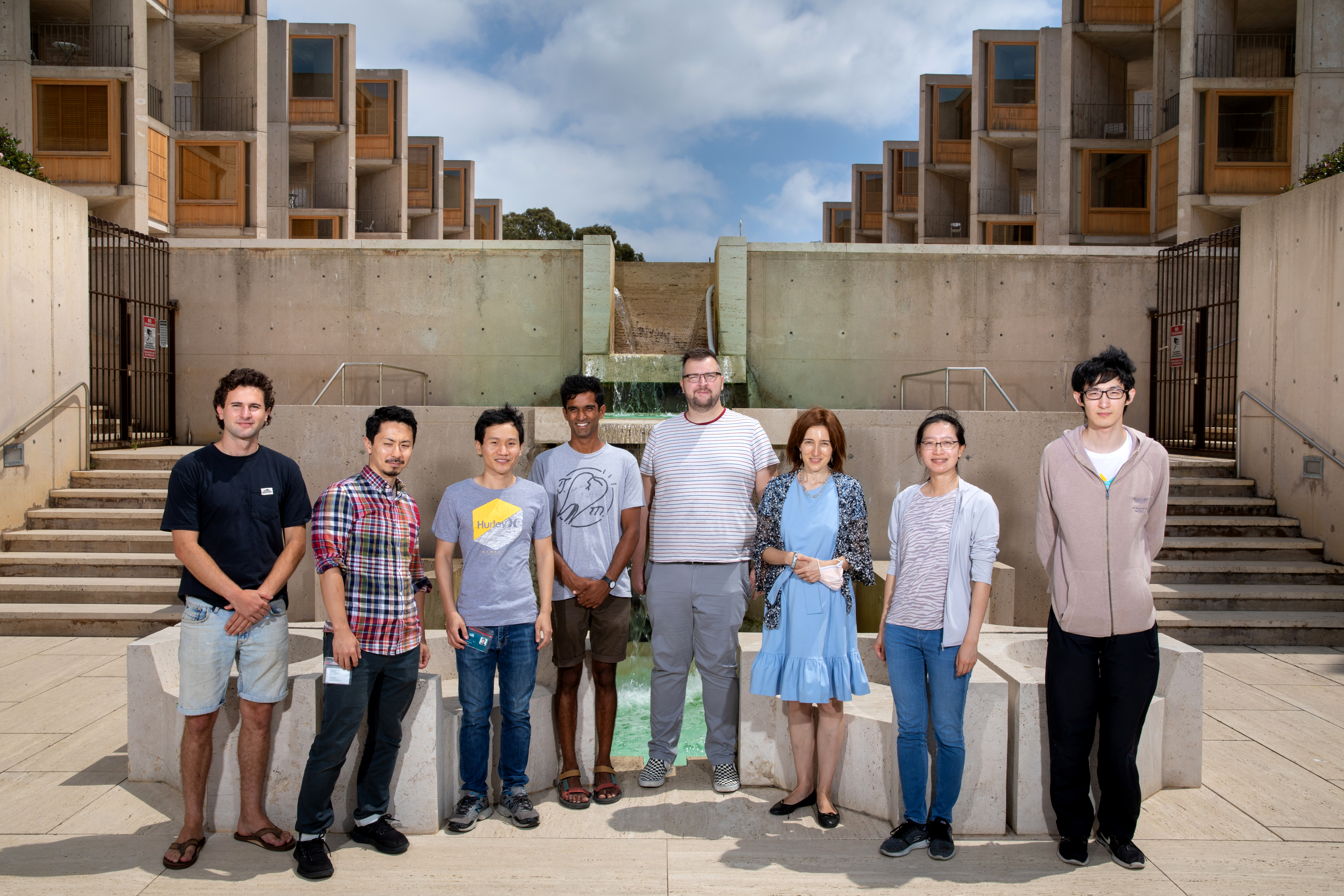
Our group works on computational principles of how the brain processes information. We are interested in how sensory processing in the brain is shaped by the animal's need to create robust and parsimonious representations of events in the outside world. There is a focus on understanding how invariant feature selectivity is achieved in cortex. We also explore the role of statistics of natural stimuli, noise, and irregularities of biological circuits in shaping the underlying neural computations. Our approaches are often derived from methods in statistical physics, mathematics, and information theory.
Latest Publications
- Sharpee, T. O. An argument for hyperbolic geometry in neural circuits., Curr Opin Neurobiol, 58, 101-104, 2019
- Sharpee, T. O. Berkowitz, J. A. Linking neural responses to behavior with information-preserving population vectors, Current Opinion in Behavioral Sciences, 29, 37-44, 2019
- Amatya, D. N. Linker, S. B. Mendes, A. P. D Santos, R. Erikson, G. Shokhirev, M. N. Zhou, Y. Sharpee, T. Gage, F. H. Marchetto, M. C. Kim, Y. Dynamical Electrical Complexity Is Reduced during Neuronal Differentiation in Autism Spectrum Disorder, Stem Cell Reports, 13(3), 474-484, 2019 PMCID:PMC6739708
- More Publications
News:
- : Tanya Sharpee wins collaborative award from NIH
- : Alex Kuczala defends his Ph.D. thesis in Physics
- : Marvin Thielk defends his Ph.D. thesis in Neuroscience
- : John Berkowitz defends his Ph.D. thesis in Physics
- : Tatyana Sharpee elected Fellow of American Physical Society
- : Tanya Sharpee receives NSF grant to study how brain processes sound
- : Wei-Mien Hsu wins Salk Women and Science Award to support her project on adaptation in neural circuits.
- : Wei-Mien Hsu wins COSYNE New Attendees travel Grant to attend conference.
- : John Berkowitz wins Shirley Chan DBIO Student Travel Award to attend 2016 Annual March Meeting of the American Physical Society.
- : Yonatan Aljadeff defends his Ph.D. thesis in Physics.
- : Ryan Rowekamp defends his Ph.D. thesis in Physics.
- : Adam Calhoun defends his Ph.D. thesis in Neuroscience.
- : Tatyana Sharpee wins CAREER Award from NSF.
- : Michael Eickenberg receives " 2012 Brains for Brains Young Researchers' Computational Neuroscience Award" from the Bernstein Association for Computational Neuroscience
- : Anirvan Nandy wins 2012 Pioneer Postdoctoral Fellowship
- : Jamie Jeanne - Thesis defense
- : Jeff Fitzgerald defends his Ph.D. thesis in Physics
- : Alfred Kaye wins National Research Service Award from NIDCD
- : Minjoon Kouh to start Assistant Professorship at Drew University
- : Adam Calhoun wins 2009 NSF Graduate Research Fellowship
- : Yuan Liu wins 2009 Pioneer Postdoctoral Fellowship
